


A Den of Thieves:
Deposits, Loans, and
Fictional Dollars
Sam Aurelius Milam III This is the third article in a series of articles that I'm presenting in this newsletter. The first article, A Den of Thieves: Fractional Reserve Banking, appeared in the December 2006 issue. The second article, A Den of Thieves: Cash Dollars In Circulation, appeared in the February 2007 issue. The articles are based on my essay They Can Fool Too Many Of The People Too Much Of The Time. Due to the limited amount of space in this newsletter, I'm eliminating from the articles a lot of material that's included in the essay. However, copies of the essay are available upon request. The essay is also
available on Pharos. For the sake of avoiding confusion, I'm
going to retain the table numbers in these articles as they appear in the
essay. Thus, the table that appears in this article is Table 4, not
Table 1. That's because it was Table 4 in the essay.
This is the third article in a series of articles that I'm presenting in this newsletter. The first article, A Den of Thieves: Fractional Reserve Banking, appeared in the December 2006 issue. The second article, A Den of Thieves: Cash Dollars In Circulation, appeared in the February 2007 issue. The articles are based on my essay They Can Fool Too Many Of The People Too Much Of The Time. Due to the limited amount of space in this newsletter, I'm eliminating from the articles a lot of material that's included in the essay. However, copies of the essay are available upon request. The essay is also
available on Pharos. For the sake of avoiding confusion, I'm
going to retain the table numbers in these articles as they appear in the
essay. Thus, the table that appears in this article is Table 4, not
Table 1. That's because it was Table 4 in the essay.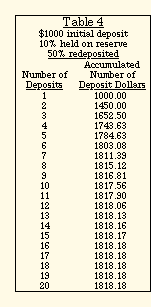 It's interesting to look at the number of dollars recorded as on deposit in the bank. I call those deposit dollars. The number of deposit dollars increases with successive deposit and loan cycles, as shown in Table 4. In that example, 1818.18 deposit dollars accumulate from an original deposit of only 1000 cash dollars. That happens when the bank loans cash dollars out of someone's account and then receives them back again as a deposit of cash dollars into another account. Although they're the same cash dollars, they're on deposit in two accounts. That happens over and over again, creating a record of deposits of cash dollars that aren't really there. It might seem superfluous to make a distinction between cash dollars and deposit dollars but the distinction is important because of a third kind of dollars. Those are deposit dollars that don't correspond to anything. I call them fictional dollars. At first, it might not be obvious. Here's what happens. When the bank receives the initial deposit, those are cash dollars. They exist physically, even if they are only green paper. When the bank makes its first loan, it loans a portion of those cash dollars and no longer has them in its possession. After the first loan, using the example in Table 4, the bank has 100 cash dollars because it kept a 10% reserve. However, it still claims 1000 deposit dollars. The difference between those two amounts represents fictional dollars which the bank says that it has on deposit but which it really doesn't have in its possession. After the bank receives the second
deposit (the previously loaned cash dollars being redeposited), there are
550 cash dollars in the bank (450 from the new deposit + 100 held on reserve
from the first deposit). However, the bank claims 1450 deposit dollars
(450 from the new deposit + 1000 from the first deposit). The second
deposit thus causes an increase in both cash dollars and deposit dollars. After the second loan, however, the number of cash dollars in the bank
decreases but the number of deposit dollars doesn't. Thus, the number
of fictional dollars (deposit dollars — cash dollars) changes from 900 to
1305. The point is that the number of fictional dollars doesn't change
after a deposit. It changes after a loan. The fictional dollars
It's interesting to look at the number of dollars recorded as on deposit in the bank. I call those deposit dollars. The number of deposit dollars increases with successive deposit and loan cycles, as shown in Table 4. In that example, 1818.18 deposit dollars accumulate from an original deposit of only 1000 cash dollars. That happens when the bank loans cash dollars out of someone's account and then receives them back again as a deposit of cash dollars into another account. Although they're the same cash dollars, they're on deposit in two accounts. That happens over and over again, creating a record of deposits of cash dollars that aren't really there. It might seem superfluous to make a distinction between cash dollars and deposit dollars but the distinction is important because of a third kind of dollars. Those are deposit dollars that don't correspond to anything. I call them fictional dollars. At first, it might not be obvious. Here's what happens. When the bank receives the initial deposit, those are cash dollars. They exist physically, even if they are only green paper. When the bank makes its first loan, it loans a portion of those cash dollars and no longer has them in its possession. After the first loan, using the example in Table 4, the bank has 100 cash dollars because it kept a 10% reserve. However, it still claims 1000 deposit dollars. The difference between those two amounts represents fictional dollars which the bank says that it has on deposit but which it really doesn't have in its possession. After the bank receives the second
deposit (the previously loaned cash dollars being redeposited), there are
550 cash dollars in the bank (450 from the new deposit + 100 held on reserve
from the first deposit). However, the bank claims 1450 deposit dollars
(450 from the new deposit + 1000 from the first deposit). The second
deposit thus causes an increase in both cash dollars and deposit dollars. After the second loan, however, the number of cash dollars in the bank
decreases but the number of deposit dollars doesn't. Thus, the number
of fictional dollars (deposit dollars — cash dollars) changes from 900 to
1305. The point is that the number of fictional dollars doesn't change
after a deposit. It changes after a loan. The fictional dollars

For PayPal payments, use editor@frontiersman.my3website.net.
Back issues are available at http://frontiersman.my3website.net/. Also see Pharos at http://pharos.my3website.net.
| April 2007 | Frontiersman, 1510 North 22nd Drive, Show Low, Arizona 85901 | Page 1 |