

Exit Pole
by Sam Aurelius Milam III
 A
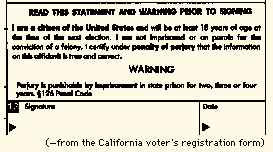
written declaration of U.S. citizenship is a prerequisite to voting in
California. It doesn't matter if you've lived here all your life,
or anything else. You must make the written declaration, and you
must make it under penalty of perjury.
Citizenship
wasn't constitutionally defined in the U.S.A. until July of 1868.
A
written declaration of U.S. citizenship is a prerequisite to voting in
California. It doesn't matter if you've lived here all your life,
or anything else. You must make the written declaration, and you
must make it under penalty of perjury.
Citizenship
wasn't constitutionally defined in the U.S.A. until July of 1868.  At
that time, by the ratification of the Fourteenth Amendment, a citizen was
defined (in part) as being someone subject to the jurisdiction of the U.S.
government. Jurisdiction means power and control. When
you register to vote, you acknowledge (under penalty of perjury) your subordination
to the power and control of the U.S. government.
At
that time, by the ratification of the Fourteenth Amendment, a citizen was
defined (in part) as being someone subject to the jurisdiction of the U.S.
government. Jurisdiction means power and control. When
you register to vote, you acknowledge (under penalty of perjury) your subordination
to the power and control of the U.S. government.
 It
isn't surprising that voter registration is voluntary. It has to
be, because that's the only way the resulting jurisdiction can be enforceable;
there is, after all, no obligation under duress. This also explains
the intense propaganda aimed at persuading people to register to vote.
The reason is that the government needs documentation of your obligation,
whereby that obligation can be proven. Remember, under the Doctrine
of Social Contract and the common law, you don't have to prove the lack
of an obligation. That's presumed. If the government believes
an obligation exists, the government must prove it. Your voter registration
form, the Fourteenth Amendment, and any good dictionary will allow the
government to do so.
When
you voluntarily become a U.S. citizen, you acquire an obligation to do
whatever the U.S. government tells you to do.
It
isn't surprising that voter registration is voluntary. It has to
be, because that's the only way the resulting jurisdiction can be enforceable;
there is, after all, no obligation under duress. This also explains
the intense propaganda aimed at persuading people to register to vote.
The reason is that the government needs documentation of your obligation,
whereby that obligation can be proven. Remember, under the Doctrine
of Social Contract and the common law, you don't have to prove the lack
of an obligation. That's presumed. If the government believes
an obligation exists, the government must prove it. Your voter registration
form, the Fourteenth Amendment, and any good dictionary will allow the
government to do so.
When
you voluntarily become a U.S. citizen, you acquire an obligation to do
whatever the U.S. government tells you to do.  When
you voluntarily register to vote, you acknowledge that obligation in a
form that can be used against you in court. The obligation is legitimate
because you joined voluntarily and you were fully informed at the time.
(Well, weren't you?) Neither the results of any election, the performance
of any elected official, nor the behavior of any bureaucrat is of any relevance.
You knew the rules and you joined anyway.
Whether
or not you were fully informed before, you are now and my advice is don't
participate. The influence of your vote, compared to the cost to
you in status, is probably the worst deal you'll ever make with the U.S.
government. It does you no good at all, it empowers those who enslave
you in the name of liberty, and (assuming you haven't already done so in
some other way) registration to vote converts your status from free man
to slave.
When
you voluntarily register to vote, you acknowledge that obligation in a
form that can be used against you in court. The obligation is legitimate
because you joined voluntarily and you were fully informed at the time.
(Well, weren't you?) Neither the results of any election, the performance
of any elected official, nor the behavior of any bureaucrat is of any relevance.
You knew the rules and you joined anyway.
Whether
or not you were fully informed before, you are now and my advice is don't
participate. The influence of your vote, compared to the cost to
you in status, is probably the worst deal you'll ever make with the U.S.
government. It does you no good at all, it empowers those who enslave
you in the name of liberty, and (assuming you haven't already done so in
some other way) registration to vote converts your status from free man
to slave.


| They
Lied Again
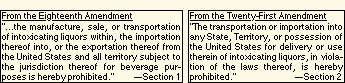
by Sam Aurelius Milam III They said that the Twenty-First Amendment repealed Prohibition which, as you can see from the quotes below, is nonsense. The Twenty-First Amendment repealed the Eighteenth Amendment, but it didn't repeal Prohibition. It revised Prohibition. How many more lies will it take before you don't believe them anymore?
 |
|
Genocide:
I recommend Gun control + Government = Genocide, by Jay Simkin,
in the September 1994 issue of Massachusetts Liberty. The article
explores the foremost reason for gun ownership. Write to P.O. Box
2610, Boston, Massachusetts 02208 or call 617 625-1100
 |
Gestapo Force
by Sam Aurelius Milam III
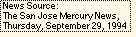 On
Tuesday, September 27, 1994 a 68-year-old grandfather armed with a 3 1/2"
pocket knife was murdered by officers of the San Jose Gestapo. It
isn't clear whether the old man was threatening the officers or trying
to surrender to them. Witnesses gave conflicting reports. Gestapo
spokesman Lt. Craig Buckhout said the officers used necessary force.
"The way we train our officers," he explained, "is that they use the necessary
force until the threat is over with. Sometimes that's nine shots,
and sometimes that's one shot." So six armed cops confronted an elderly
man in a parking lot, fired a total of 9 shots at him, and killed him.
According to the Gestapo, that's necessary force. I'll tell you what
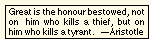
I think. Policemen should never be permitted to carry weapons.
It's never a policeman's job to kill someone. Never. There
is always an alternative. When all else fails, a beleaguered cop
can back down. With 6 to 1 odds against an old man, they could have
subdued him. They didn't need to kill him. The officers who
did it should have their trigger fingers amputated.
On
Tuesday, September 27, 1994 a 68-year-old grandfather armed with a 3 1/2"
pocket knife was murdered by officers of the San Jose Gestapo. It
isn't clear whether the old man was threatening the officers or trying
to surrender to them. Witnesses gave conflicting reports. Gestapo
spokesman Lt. Craig Buckhout said the officers used necessary force.
"The way we train our officers," he explained, "is that they use the necessary
force until the threat is over with. Sometimes that's nine shots,
and sometimes that's one shot." So six armed cops confronted an elderly
man in a parking lot, fired a total of 9 shots at him, and killed him.
According to the Gestapo, that's necessary force. I'll tell you what
I think. Policemen should never be permitted to carry weapons.
It's never a policeman's job to kill someone. Never. There
is always an alternative. When all else fails, a beleaguered cop
can back down. With 6 to 1 odds against an old man, they could have
subdued him. They didn't need to kill him. The officers who
did it should have their trigger fingers amputated.
 Actually,
maybe all cops should have their trigger fingers amputated as a prerequisite
to being cops. If they don't like it, then they can go after data-entry
jobs, where they'll have an excuse for needing all their fingers.
Actually,
maybe all cops should have their trigger fingers amputated as a prerequisite
to being cops. If they don't like it, then they can go after data-entry
jobs, where they'll have an excuse for needing all their fingers.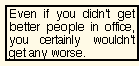 Selections
would be much cheaper than elections because the entire process could be
financed by admission tickets, sponsors, network broadcast contracts, and
so forth. You could select your political figures according to their
performance judged against a set of standards not unlike those of the Miss
America contest. Maybe for extra excitement you could have some events
patterned after the American Gladiators competitions. The contestants
would need to be healthy, attractive, intelligent, quick-witted, friendly,
and courteous. They'd have a better chance if they could sing, dance,
or tell jokes. The winners would get to travel around a lot, make
lots of guest appearances, do some commercials, and get practical jokes
played on them. Most important, they'd be so busy acting like celebrities
that they probably wouldn't have much time to do a lot of damage to the
country. Even if you didn't get better people in office, you certainly
wouldn't get any worse and they wouldn't have all those promises to break.
Something to think about, eh? Try it. You might like it.
Selections
would be much cheaper than elections because the entire process could be
financed by admission tickets, sponsors, network broadcast contracts, and
so forth. You could select your political figures according to their
performance judged against a set of standards not unlike those of the Miss
America contest. Maybe for extra excitement you could have some events
patterned after the American Gladiators competitions. The contestants
would need to be healthy, attractive, intelligent, quick-witted, friendly,
and courteous. They'd have a better chance if they could sing, dance,
or tell jokes. The winners would get to travel around a lot, make
lots of guest appearances, do some commercials, and get practical jokes
played on them. Most important, they'd be so busy acting like celebrities
that they probably wouldn't have much time to do a lot of damage to the
country. Even if you didn't get better people in office, you certainly
wouldn't get any worse and they wouldn't have all those promises to break.
Something to think about, eh? Try it. You might like it.


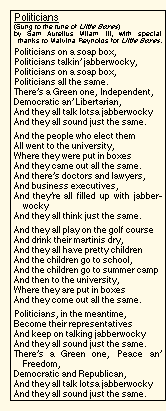 I
don't necessarily even support the idea of democracy, but the nearly universal
propaganda in its favor assures that people will be lining up to vote for
quite some time to come. This gives a certain importance to the problems
inherent in democracy.
I
don't necessarily even support the idea of democracy, but the nearly universal
propaganda in its favor assures that people will be lining up to vote for
quite some time to come. This gives a certain importance to the problems
inherent in democracy.




 ,
435 South White Road, San Jose, California 95127
,
435 South White Road, San Jose, California 95127